

The Field Report Newsletter | Issue 4
There’s a version of revenue leadership that looks clean from the outside. Pipeline is reviewed weekly. The go-to-market strategy is thoroughly documented. Sellers are consistently trained on the product differentiators and the winning deal behaviors. The number is the number.
Then you look at what’s happening in the field, and it’s a different story. A tariff shifts land costs mid-deal, and your seller is three hours from a desk. A distributor gets acquired, and your champion no longer has authority to sign. But, perhaps most commonly, a buying committee adds three new stakeholders or an entire AI council your rep has never met. None of it showed up in the forecast.
These aren’t edge cases. This is your team’s everyday reality.
Deals in complex selling environments often stall because of stakeholder misalignment. Every decision-maker brings a different evaluation framework shaped by the complexity of the solution being sold. This widens the distance between “yes from a champion” and “yes from the organization.” Deals aren’t definitively lost to a competitor, but slowly dissolve into an internal buying process your seller can’t see and can’t influence.
This is the buyer expectations gap. What makes this gap worse for field-selling organizations? Time and space. An inside sales rep can hop on a Zoom to address a new stakeholder who entered the deal. A field seller has to get on a plane, drive three hours, or wait for the next scheduled site visit. Every week of delay is a week for the committee to lose momentum, reprioritize, or stick with the status quo.
The no-decision outcome isn’t a soft loss. In field selling, it’s the most expensive outcome there is. Every no-decision carries the full cost of windshield time, flights, meeting prep, product trials, and months of relationship-building — all for a deal that just mysteriously fizzled.
Those who are making effective countermoves are giving their champion the tools to sell internally on their behalf. A one-page business case tailored to the CFO, a risk summary for procurement, detailed technical specs for IT — the specific answers each stakeholder needs to say yes when the seller is not in the room.
So here’s what I’d ask you to sit with: When your seller leaves the meeting, does your go-to-market motion leave with them?
Amanda Bedborough
Chief Revenue Officer, Showpad
Every issue we talk to a thought-leader to get their takes on the revenue effectiveness space. Today, we’re joined by Karan Khiani, founder and CEO of Enablism, an AI-powered value enablement platform that helps teams build business cases with buyers and carry those commitments through the customer journey. His experience in presales and product roles led him to build Enablism after repeatedly creating tools to help buyers answer: “Is this worth it?”
#1 Why do so many deals stall after everyone agrees the product is a good fit?
Think of the energy it takes to overcome gravity. Organizations have their own human inertia, and a seller needs help from within to overcome it. What tools are you giving the people who want change? Equip them with a business case they believe in and can use to bring others along.
#2 Finish this sentence: “Buyers don’t need more information. They need…”
…someone to help them find a path they believe in. Often they already know where they want to go, but need help working through the decision. Your role is to guide them and test that path together, so they have the conviction to move forward.
#3 What’s the difference between proving value and claiming it?
Proof means following through after the sale and measuring whether the promised value showed up. Some teams are starting to do this. It remains difficult because you need an agreed starting point and continued access to results. The business case becomes a commitment you keep working on with the customer.
#4 How is AI changing the way buyers decide whether something is worth it?
AI lets buyers tinker and build proofs of concept to help make the case internally. Sellers need to first recognize how far they've already come and then help their buyer take the next step. That means showing how your solution gives them the security and guardrails they need as their business evolves.
#5 Where do sales teams most often lose credibility when making a business case?
When they treat the business case as finished. Discovery continues after the customer signs, and our view of their evolving business is always limited. Credibility starts with acknowledging that. Keep the case open to collaboration so customers can bring in what they've learned and give different stakeholders room to weigh in.
The Dig
Not a data dump. One number — unearthed because it reveals something beneath the surface and examined for the teams confronting it in the field.
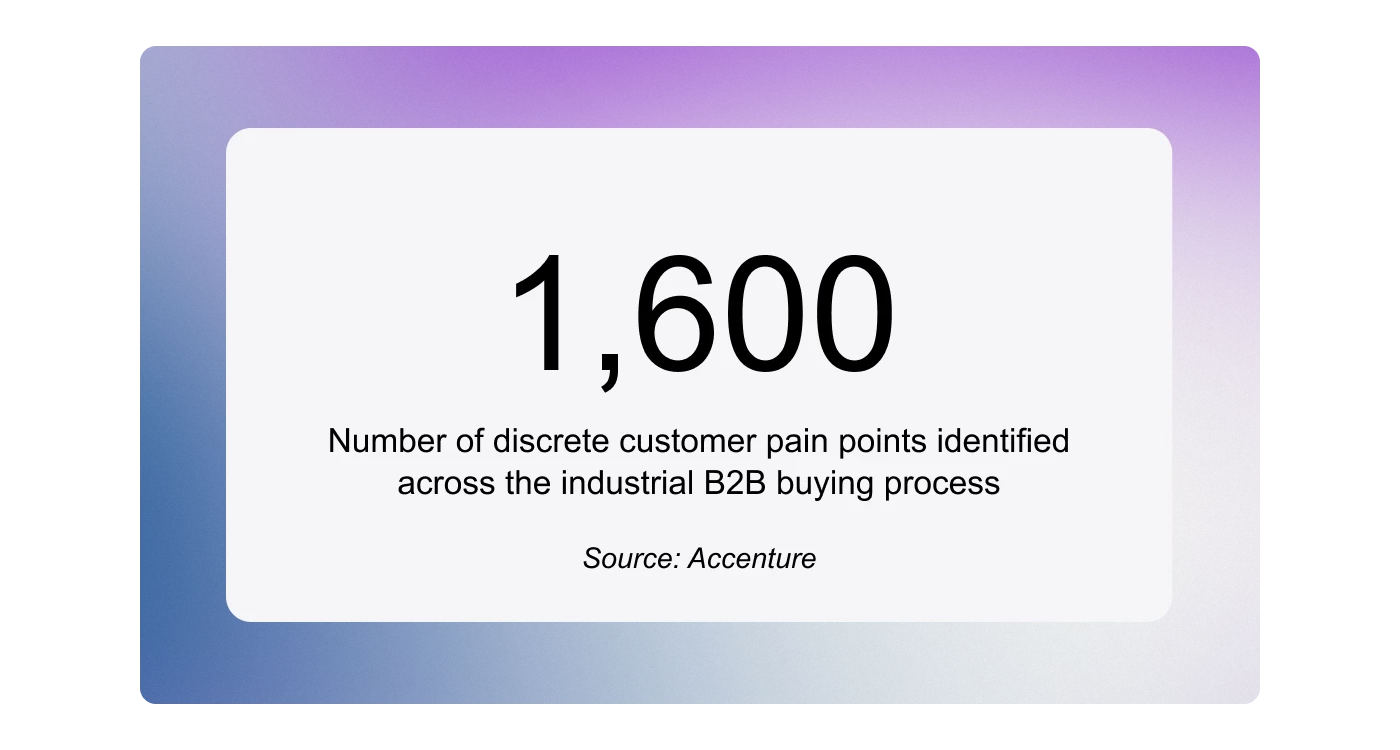
Not complaints. Not NPS comments. Accenture’s research team mapped the entire buying journey for industrial B2B purchasers — from initial research through evaluation, procurement, and post-sale — and cataloged sixteen-hundred distinct points where the experience breaks.
The number itself is almost beside the point. What it reveals is that buying from you is an obstacle course your buyer runs while also doing their actual job. And most of those roadblocks are invisible to the selling organization, because they live in the spaces between your teams — the handoff from marketing to sales, from sales to procurement, from procurement to implementation. Every one of those seams is a place where the buyer’s journey can fracture and their confidence can erode.
Your champion isn’t just selling your product internally. They’re navigating more than a thousand potential friction points, most of which have nothing to do with whether your product is any good.

The terrain your team sells across is always shifting. In each issue, we zoom out to a big-picture force reshaping the markets, and zoom in on a ground-level shift worth tracking.

Zoom Out: Macro force shaping markets
The compliance creep
In the past 18 months, a wave of government regulations has landed on the industries where field sellers operate — and they’re still coming. The FDA in the US overhauled its quality management requirements for medical device manufacturers. The EU began requiring carbon certificates for every shipment of steel, aluminum, cement, and fertilizers. Extended Producer Responsibility laws spread across global markets, making manufacturers accountable for the environmental impact of products long after the sale.
None of this is about sales. But all of it is reshaping how your customers buy.
Every new law adds a stakeholder to the purchasing process who didn’t exist three years ago. A sustainability lead who needs to verify a supplier’s carbon footprint. A compliance officer who needs documentation your rep has never been asked to provide. These new stakeholders sit between your champion’s “yes” and the signed order — often in a queue your rep can’t see and your CRM doesn’t track.
The organizations adapting are mapping the regulatory landscape their customers operate in. Because if your rep doesn’t know the buyer needs a carbon accounting review or a PFAS attestation, that deal will dissolve.
The question for your revenue team: Do you know what your buyer has to prove — to their regulators, not just their boss — before they can sign?

Zoom In: Micro trend worth watching
The conflict inside the committee
Most revenue leaders explain stalled deals with some version of “the buying committee couldn’t get aligned.” That framing makes it sound like a timing problem — give them another meeting, and they’ll converge.
What we’re seeing is more structural. The conflict that kills deals isn’t about features, pricing, or timing. It’s about who gets to decide and whose priorities take precedence. It’s political, not procedural.
The surgeon evaluated clinical outcomes. The procurement lead calculated the total cost of ownership. The IT director measured integration risk. None of them are wrong — but their viewpoints are fundamentally different, and nobody in the room has the authority or context to reconcile them.
The organizations paying attention to this are distinguishing between two kinds of stalled deals. In one, the committee agrees on what they want but hasn’t found time to finalize it — patience fixes this. In the other, the committee is in genuine disagreement about what they’re even evaluating — and more meetings just surface more conflict. The second one doesn’t un-stall on its own. It defaults to the safest available option, which in complex field sales is almost always no-decision.
What you should be checking: When a deal stalls in committee, is your team diagnosing it as a timing problem or a conflict problem?
Overheard in the Field
One line. No attribution. What gets said between meetings, after QBRs, or while clocking windshield time. If it sounds familiar, that’s the point.
| 
|
| GREAT LISTEN Hidden Brain, “Group Think” Shankar Vedantam’s podcast episode on how group loyalties reshape our opinions, and our basic perception of what we’re looking at. Psychologist Jay Van Bavel walks through research showing that once people identify with a group, they process information differently than outsiders — same data, different conclusions, and neither side thinks they’re being biased. It’s a lens on why alignment is so much harder than it looks and why “just get everyone in the room” rarely solves what you think it will.
| GREAT FOLLOW Packy McCormick’s “Not Boring” newsletter If you read one newsletter about the physical economy, make it this one. McCormick does deep dives on companies in manufacturing, industrial tech, and physical AI — rare-earth magnets, drones, the economics of actually making things. The writing reads like the business strategy content that should exist for your industry but usually doesn’t. Most thought leadership is written for people who sell software. This is for people who sell in the real world.
|
| 
|
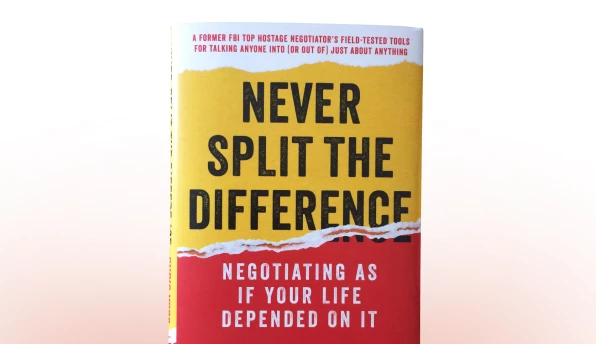
| GREAT READ “Never Split the Difference” by Chris Voss With 24 years at the FBI, Voss was trained on the art of negotiation at the Bureau, but also by Scotland Yard and Harvard Law School. He surmised that the most dangerous negotiation mistake isn’t being too aggressive — it’s being too reasonable. Voss dismantles the idea that deals close when both sides find a logical middle ground. What actually moves people is feeling heard, and the techniques he teaches — tactical empathy, labeling emotions, calibrated questions — work because they address what’s happening beneath the surface of any high-stakes conversation. Short, blunt, full of field stories.
| GREAT IDEA Applying the “pre-mortem method” to your deals Cognitive psychologist Gary Klein Ph.D. developed the pre-mortem as a decision-making tool: before committing to a plan, assume it already failed, ask everyone to write down why. It’s been adopted by hospitals, military units, and product teams, and it works because it gives people permission to voice doubts. Apply it to your pipeline. For any deal in progress, gather the account team and say: “It’s six months from now, and this deal is dead. What happened?” You’ll surface unforeseen risks — the stakeholder no one’s spoken to, the internal priority that outranks your project, the budget cycle nobody checked.
|

Dispatch from Base Camp
Direct from Showpad HQ. One thing we’ve built — and why it matters for the teams we serve.
Meet the 2026 Excellence in Action Award winners
For our second year, we asked our customers and partners to show us what great revenue effectiveness looks like in practice with our awards program, Excellence in Action. This year, 67 teams applied, the community cast 1,700 votes, and five Showpad leaders chose 11 winners in categories ranging from AI and field selling to channel enablement and buyer engagement.
The entries came from laboratory services, medical devices, energy, manufacturing, and consumer goods. What the winners had in common was follow-through: clear ownership, steady iteration, and the patience to make change stick.
Each winner has a story worth reading, with the challenge, build, and numbers behind it. Take a few minutes with them, and join us in congratulating this year’s stars.
In the last edition of The Field Report we asked: What happens to your deals after the second meeting?
There was no clear winner — a near perfect four-way split. Which means there’s no shared playbook for what happens after the first meeting goes well.
Some build a second meeting into a genuine inflection point. Others watch deals quietly bleed out in the gap between meetings and can’t pinpoint why. And one group isn’t tracking meeting-to-meeting progression at all — which means the drop-off could be happening but it’s invisible. The second meeting might be the most under-examined moment in complex field sales.
When was the last time your team autopsied your second meetings in aggregate?
Thanks for reading The Field Report. If this earned a spot in your inbox, forward it to someone who’d get value from it, too. Someone send this to you? Get it directly by subscribing here and check out the previous issues while you’re there.
Next up: poll results, a new guest in the hot seat, and more findings from the field.